

Choosing MBBS in Russia is a significant academic and financial decision, particularly for Indian students who intend to return home for their medical careers. Instead of beginning with rankings or promotional fee packages, students should first understand how overseas medical education fits into their long-term professional pathway.
For MBBS aspirants from Varanasi and nearby districts of Uttar Pradesh, the planning process should begin well before university applications are submitted.
Start with eligibility, not the university shortlist
Indian candidates should verify their eligibility for overseas medical education before progressing to admission.
NEET remains particularly important. NMC information explains that qualifying NEET is mandatory under the applicable rules for Indian citizens and OCI candidates seeking admission to MBBS or equivalent medical education outside India, with the NEET result serving as the eligibility certificate for relevant candidates under the current framework.
Students should therefore avoid treating an overseas admission letter as proof that every Indian regulatory requirement has automatically been satisfied.
Understand the complete medical program
Universities can differ in curriculum, academic calendar, clinical exposure, internship arrangements, local licensing requirements, and language environment.
Before choosing a Russian medical university, investigate:
- Total duration of the program
- Medium of instruction
- Curriculum and mandatory subjects
- Clinical teaching arrangements
- Hospital affiliations
- Internship structure
- Assessment pattern
- Local language requirements during clinical interaction
- Eligibility to obtain registration or a licence in Russia
- Documentation provided after graduation
These details matter because the NMC's Foreign Medical Graduate Licentiate Regulations establish specific conditions for foreign medical graduates covered by the regulations. These include requirements concerning course duration, internship, English-medium instruction, mandatory subjects and eligibility for professional registration in the country where the degree is awarded.
Why local language preparation can matter
An English-medium medical program does not necessarily mean every patient encountered during clinical training will communicate in English.
Medical students eventually need to take histories, understand symptoms and communicate in clinical environments. Students evaluating Russia should therefore ask how the university prepares international students for communication with local patients.
This is an academic consideration, not merely a lifestyle issue.
Calculate the complete cost
An advertised tuition figure is not the same as the total cost of studying medicine overseas.
Parents should prepare a multi-year estimate covering tuition, accommodation, meals, insurance, visa-related expenses, flights, local transportation and personal costs. Currency movements can also affect the rupee value of expenses over several years.
A written year-by-year estimate is much more useful than comparing universities using one headline figure.
Consider life beyond admission
Students leaving Varanasi for an overseas university also need to adjust to a different climate, food environment, academic culture and level of independence.
Before finalising a university, speak openly as a family about:
- Ability to live independently
- Adaptation to weather
- Food preferences
- Financial discipline
- Academic consistency
- Communication with family
- Emergency support arrangements
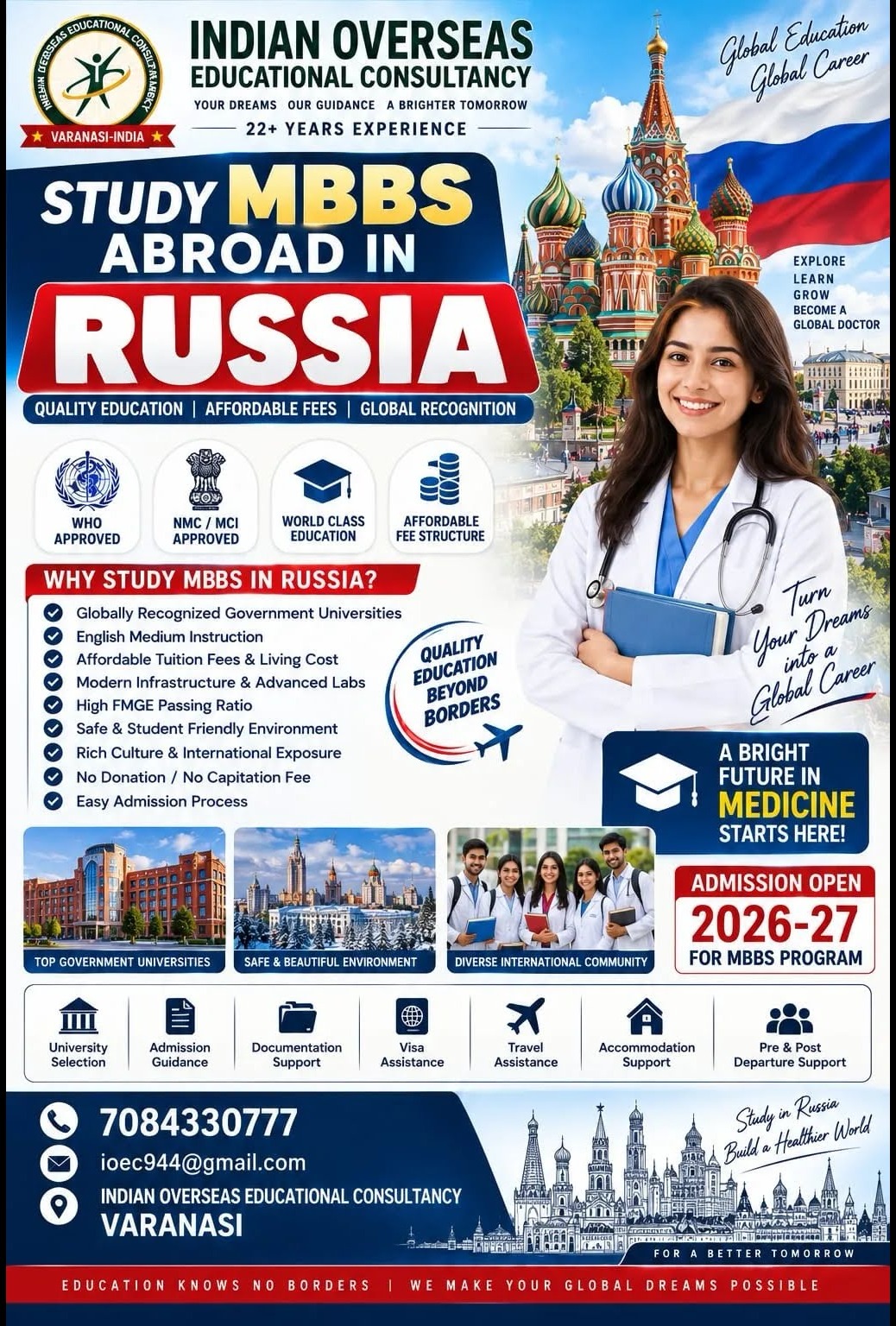
Indian Overseas Educational Consultancy works with students and parents in Varanasi who are exploring international medical education and need structured assistance with university evaluation, applications and documentation.
The right MBBS in Russia decision should not be based on a single attraction such as affordability. Students should evaluate whether the entire academic pathway, clinical environment, regulatory framework and financial commitment fit their career objectives.